How to Get Ahead of the Pack: Maximizing Airbnb Revenue in 2027

2027 will reward the hosts who start preparing before January, not the ones who react in March. The market is finally tilting in favor of owners who already have a property and run it well.
Here is what changed since our 2025 list. Supply growth has cooled: new U.S. listings grew about 4.5% in 2025, down from 9.5% in 2024, and AirDNA forecasts ADR gains of 1.5% in 2026 with faster growth in 2027 (AirDNA 2026 Outlook, AirDNA STR Data Lab). AirDNA's July 2026 midyear update put it plainly: this is a better year to own than to buy, because slower supply growth is giving existing hosts pricing power (AirDNA Midyear Outlook).
At the same time, Airbnb itself changed more in 2026 than in any year since the pandemic. A single 15.5% host-paid fee, AI search, AI-written listing summaries, a native dynamic pricing tool, and hotels sharing the same search results. The "no está saturado, está mal ejecutado" truth still holds: the market isn't saturated, it's poorly executed. These five moves are how you execute in 2027.
1. Reprice for the 15.5% fee, then price with intelligence
If you haven't adjusted your rates for the host-only fee, you are quietly giving away margin. Airbnb is moving every host to a single 15.5% host-paid fee by the end of 2026, and its own CFO has said the structure puts downward pressure on prices (Rental Scale-Up, Q2 2026). The guest no longer sees a separate fee, so the number on your calendar is now the whole story.
What to do before 2027:
- Rebuild your floor price. Start from your true cost per night (cleaning, utilities, supplies, platform fee, taxes, debt service). Your minimum rate should never fall below it.
- Decide on Airbnb's new pricing tool deliberately. The Fall 2026 release added native dynamic pricing that adjusts daily within a range you set (Shorttermrentalz). It's convenient, but Airbnb has also tested trading search ranking for host-funded discounts (Rental Scale-Up). If you use it, set the range yourself. Many pros still run PriceLabs or a similar tool as the brain.
- Map your 2027 compression nights now. Holidays, local events, and peak weekends get booked 4 to 9 months out. Price them high early; you can always come down.
- Fill gap nights on purpose. Use orphan-night rules and lower minimum stays for 1–2 night gaps between bookings instead of blanket discounts.
- Track RevPAR, not just occupancy. A full calendar at the wrong price is a busy way to earn less.
2. Write your listing for the AI, not just the guest
In 2027, your first reader is Airbnb's AI. U.S. guests can now search in their own words or by voice, Airbnb writes its own short summary of your home in search results, and wishlisted homes are compared side by side by AI (Hostaway, Rental Scale-Up). Spoken searches are longer and more specific, so the AI matches on details. Vague copy gives it nothing to work with.
How to get ready:
- Complete every amenity field. If a guest says "lake house with a pool for two families and a crib," the AI can only match what you've checked off.
- Be specific, not poetic. "5-minute walk to the lake, heated pool open May–September, 2 king beds, 1 queen, 2 twins" beats "a relaxing getaway."
- Answer the questions guests ask you. Put your most common pre-booking questions (parking, stairs, pet policy, check-in) directly in the listing so the AI can answer them for you.
- Protect your review data. AI summaries pull from reviews. Recurring complaints about cleanliness or Wi-Fi will surface in your summary, so fix the root cause, then ask for reviews that mention the fix.
- Re-read your listing quarterly. Search "in your own words" for your property type and see whether you show up and how Airbnb describes you.
3. Earn the rate with experience, not discounts
The hosts who win in 2027 justify their price instead of cutting it. Hotels now appear in the same Airbnb search results as your home (Rental Scale-Up, Q2 2026), so "cheaper than a hotel" is no longer enough. You need to be better than a hotel for the guest you serve.
- Pick one guest and design for them. Families, remote workers, girls' trips, lake weekends. Every amenity and photo should say "this was made for you."
- Invest in the amenities guests search for. Fast Wi-Fi with a posted speed, a real workspace, quality mattresses, a stocked kitchen, and one standout feature (pool, game room, view) that becomes your headline photo.
- Systemize the five-star basics. A clear check-in message, a digital guidebook, a mid-stay check-in, and a cleaning checklist with photo proof. Consistency is what produces a 4.9+ rating over hundreds of reviews.
- Respond before the AI does. Airbnb's AI assistant can now field guest issues before they reach you (Hostaway). Fast, warm host replies keep you in control of the story.
- Add paid upsells. Early check-in, late checkout, pool heat, welcome packages. Small add-ons raise revenue per stay without touching your nightly rate.
4. Own more of your guests
Airbnb just put a price on the guests it finds for you, and it's bigger than most hosts assumed. In a U.S. pilot reported in August 2026, bookings that come through a host's own "direct booking link" carry a 6% or 10% fee instead of 15.5% (Rental Scale-Up, RedAwning).
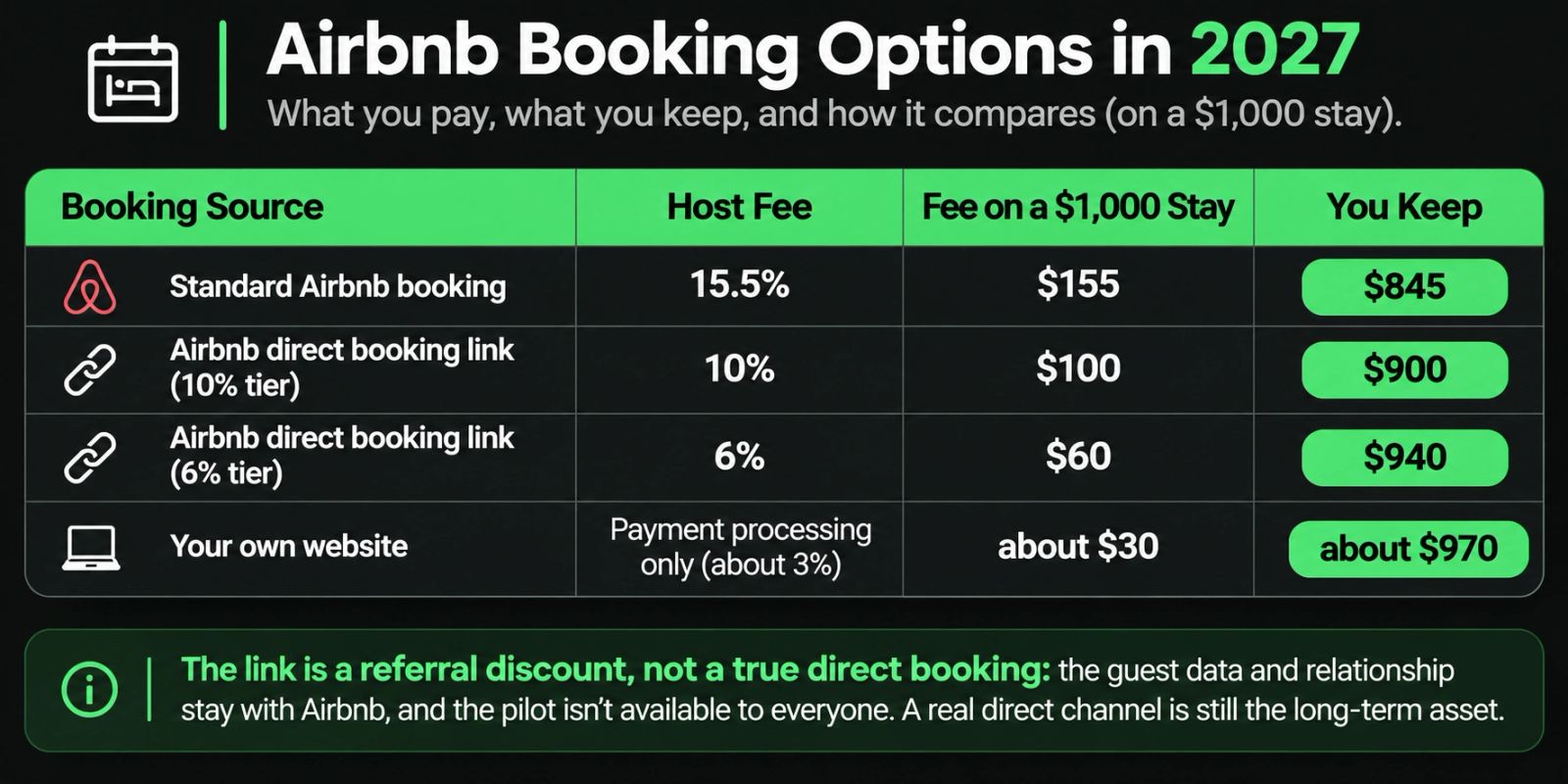
The link is a referral discount, not true direct booking: the guest data and relationship stay with Airbnb, and the pilot isn't available to everyone. A real direct channel is still the long-term asset.
- Launch or tune your direct booking site (Hospitable, OwnerRez, Hostaway and similar tools make this simple), and keep your rates consistent with Airbnb.
- Capture repeat guests ethically. Use your guidebook, Wi-Fi landing page, and post-stay follow-up to invite past guests to join your list.
- Build an email list and a social presence around your property and your area. Your content is your marketing budget.
- List on a second channel like Vrbo or Booking.com so one algorithm change doesn't control your income.
- If you get the Airbnb link, use it in your social posts and emails while you build your own site.
5. Run it like a business: books, taxes, and rules
Revenue is only half the game; what you keep is the other half. As a CPA, this is where I see the biggest gap between average hosts and the top 10%.
- Keep monthly books, not shoebox receipts. Separate bank account, categorized income and expenses, and a monthly P&L. You can't improve a number you don't track.
- Understand the short-term rental tax strategy. When your average guest stay is seven days or less and you materially participate, rental losses may be treated as non-passive and offset other income. The One Big Beautiful Bill Act permanently restored 100% bonus depreciation for qualifying property acquired after January 19, 2025, which makes a cost segregation study far more powerful (AirROI, Taxstra).
- Mind the placed-in-service date. A property bought in 2026 generally needs to be ready and available for rent by December 31 to claim depreciation on your 2026 return.
- Log your hours now. Material participation is proven with documentation: a dated log of guest messaging, cleaning coordination, maintenance, and pricing work. Reconstructing it in April is painful and risky on audit.
- Check your local rules every year. Permits, occupancy taxes, and HOA restrictions keep changing. A fine or a shutdown wipes out a year of optimization.
Tax rules depend on your facts. Talk with a CPA who works with short-term rentals before acting on any of these strategies.
Your getting-ahead checklist for the next 60 days
The best time to win 2027 is the rest of 2026. Start here:
- Recalculate your floor price with the 15.5% host fee built in
- Set 2027 rates for holidays, events, and peak weekends
- Rewrite your listing with specific, AI-readable details and complete every amenity field
- Fix the top complaint in your last 20 reviews
- Launch or refresh your direct booking site and start collecting guest emails
- Close your 2026 books and schedule a tax planning meeting before December 31
- Confirm your permits and local rules for 2027
At Terminus Hospitality, we help owners do exactly this: smart pricing, five-star guest experience, and the financial clarity that only a CPA-led team can bring. If you want a second set of eyes on your property before 2027, contact us for a consultation.
Sources
- AirDNA U.S. 2026 Outlook Report
- AirDNA 2026 and 2027 Midyear Update (July 8, 2026)
- AirDNA STR Data Lab: 2026 STR Outlook
- Rental Scale-Up: Airbnb 2026 Fall Update for hosts
- Rental Scale-Up: Airbnb Q2 2026 earnings
- Rental Scale-Up: Airbnb AI pricing model
- Rental Scale-Up: Airbnb direct booking links
- Hostaway: What the Fall 2026 Update means for hosts
- Shorttermrentalz: Airbnb AI pricing and portfolio tools
- RedAwning: Direct booking links explained
- AirROI: STR bonus depreciation 2026
- Taxstra: Short-term rental tax loophole 2026 guide
Want a hands-off, high-performing rental?
Terminus Hospitality handles listings, pricing, guests, cleaning and maintenance.
Request a consultation